
Tracking assets: RFID meets industrial Wi-Fi
Globalisation and mobility trends have profoundly affected industrial plant operations and entire business
models, with assets that make up the supply chain being constantly in motion. Efficiently managing people,
products, equipment and raw materials is essential to keep global manufacturers competitive. One fast
growing technique that enables this is a combination of wireless networks with RFID technology.

IN THE PAST, a lack of visibility into the
location of valuable assets has hindered
efficiency and resulted in operational problems
such as misplaced mobile tools, jigs, machinery,
parts, or work-in-process (WIP) inventory. This
results in high equipment leasing and/or
replacement costs to offset losses.
Worker safety and security is another issue.
Accidents and security incidents can make it
life-critical to quickly locate employees and
building exit routes. Context-aware conditions
help minimise injury and losses. As manufacturers
seek to continuously improve business
agility, quality, reliability and safety, they are
taking advantage of increasing intelligence in
devices and networks.
Increasingly 'smart' devices, which include radio
frequency identification (RFID) tags and sensors
that have advanced diagnostics, are contributing
to the billions of devices now connected to IP
networks. This proliferation of smart devices is
referred to by some as the 'Internet of Things', and
it is projected to grow to trillions of devices that
will be connected using the emerging IPv6
protocol1. For manufacturers, a growing number
of connected smart devices promises to revolutionise
portability, mobility, context-aware
condition and use of critical assets.
However, devices must be continuously
connected - including in tough manufacturing
environments - and be integrated to deliver
context-rich information, alongside with data.
The combination of smart devices with wireless
networks is now able to deliver powerful smart
services, such as context-aware, real-time asset
management and location services.
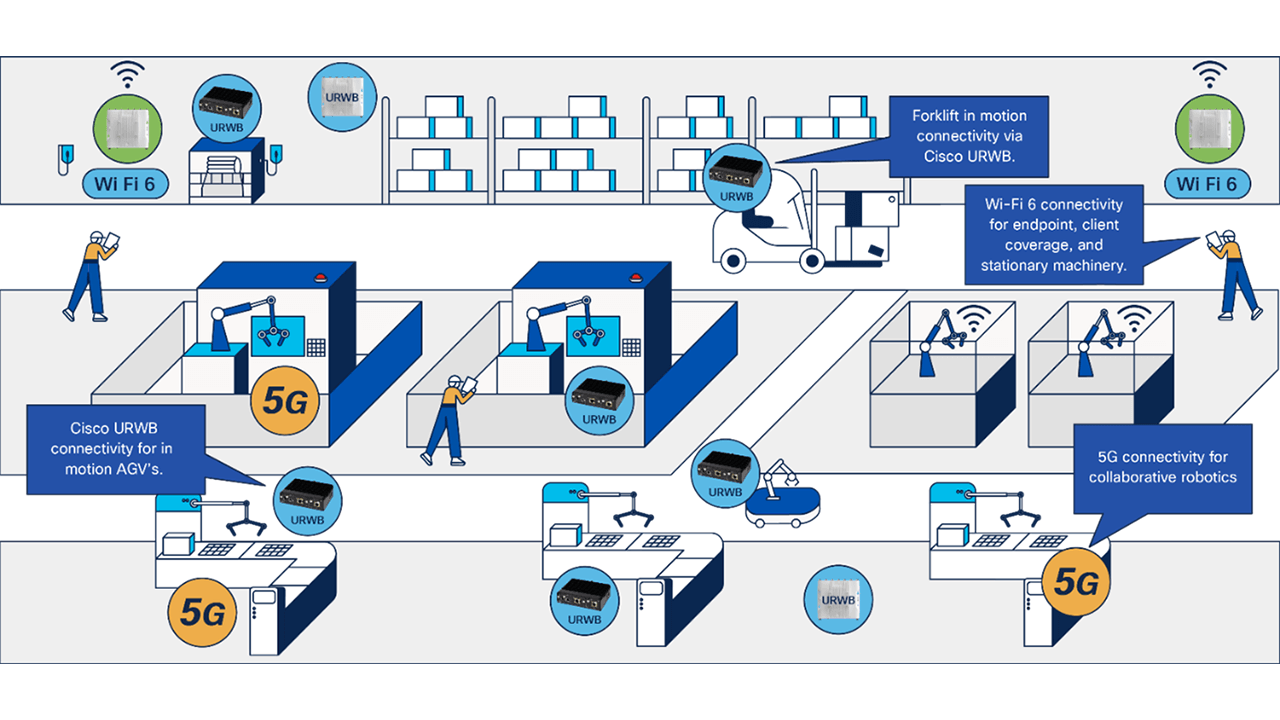
RFID + wireless
Technology analyst firm IDC included smart
services using RFID as one of its ten
Manufacturing Industry Predictions for 20112.
Indeed, the past year has seen an explosion of
RFID solutions used to track almost everything
imaginable.
Research firm Gartner suggests that the
explosion of mobile smart devices is leading
to an equivalent explosion of mobile applications,
which will create new wireless
infrastructure requirements3. When RFID
solutions are teamed with wireless networks,
manufacturers can suddenly increase operational
visibility almost anywhere. Today, RFID
and wireless networks are able to deliver
immediate, unprecedented visibility into assets,
WIP and people's locations.
Manufacturers have been piloting and
deploying RFID in their organisations for some
time, and several trends are developing.
Passive or active?
There are both 'passive' and 'active' RFID tag
types. Passive RFID uses low cost tags that are
generally disposable as consumables (as used
in shops to prevent theft etc), while active
RFID uses more sophisticated tags that cost a
little more at typically Euro 17 - 68 ($25-
$100). There is also a third type - semi-passive
tags. These are similar to active tags in that
they use a battery to run the microchip's
circuitry, but they cannot communicate with
RFID readers. To conserve battery life, some
semi-passive tags remain in a 'sleep' mode until
contacted by a reader.
Active RFID tags possess greater functionality
and tend to be associated with supply
chain or manufacturing process workflows. They
are reusable and have batteries that last five
or more years. Active RFID tags can also
function as low-cost remote sensors that
broadcast telemetry back to a base station.
Active-RFID deployment is a sector that is
seeing good payback and return on investment
for manufacturers.
Looking at wireless transmission, work with
RFID and the Real Time Location System (RTLS)
has led to the development and support of
multiple RFID technologies. The first is
Received Signal Strength Indicator (RSSI). This
is a measurement of the power present in a
received radio signal. RSSI is generic radio
receiver technology metric, which is usually
invisible to the user of the device containing
the receiver, but is directly known to users of
wireless networking of IEEE 802.11 protocol
family.

RFID technology
Active RFID tags have an onboard battery to power the microchip's circuitry and transmit signals to
readers. Typically, active tags can be read from distances of around 30m. They also allow more
applications by offering two-way communications, sensor integration, independent system
intelligence, and constant viability. Active RFID tags work using Received Signal Strength Indication
(RSSI) or Time Difference of Arrival (TDOA) technologies.
RSSI: Some tags associate with APs to provide a regular beacon or 'chirp' (a 416-bit 802.11 frame).
This reduces tag/AP interaction to a simple unidirectional packet - there is no state for the AP to maintain
and no IP address required. Also, less radio time means a longer battery life. This is common amongst
IEEE 802.11 wireless protocol families, whether a, b, g or the newer n flavour. Other tags send out a
more constant signal, become associated with the AP, providing a more constant awareness with
stronger integration. However, battery life is shorter.
In an 802.11 Wi-Fi network, the APs are arranged so that they receive signals from the RFID tag and
triangulate its position based on the received signal strength at each AP. The stronger the signal, the
closer the tag is to the AP. Each AP sends it's strength metric to the wireless control system, which
interprets the signal strength via an appliance and middleware. This provides coordinates via APIs to
user interface software, which - in turn - specifies location. The results can be sent as coordinates
or shown on a visual map.
For Lightweight Access Point Protocol (LWAPP) environments, location information is sent to the Location
Appliance andWireless Control System (WCS) rather than an alternative separate non-LWAPP engine,
which can also calculate tag positions. Accuracy can be 2 - 3m, depending on environment, location
and AP density.
TDOA: This is similar to RSSI in that the network APs triangulate tag locations based upon the signal,
but here it is the time it takes for the signal packet(s) to arrive at the AP that is important. The shorter
the time taken for the signals to be detected, the closer the tag is to the AP, and a position is estimated
using one or more locating algorithms in the location appliance andWCS. This method is more resilient
for high ceilings and outdoor applications, and is less disturbed by building structures.
In another application there are chokepoints ('exciters'). This works using strategically placed readers
or triggering devices - the exciters.When a tag passes within range of a 125 kHz exciter, the tag emits
a short burst ofWi-Fi data that includes that exciter's unique identification.With an exciter, immediate
tag recognition occurs as the tag is 'excited' and emits a response. Conventionally, it can take several
minutes before tags chirp and the location is updated. Exciters, therefore, provide a more real-time
experience for tracking moving items. Additionally, tags can be set to turn themselves on or off as they
go through chokepoints.
In summary, RSSI is good for most indoor tracking applications and uses existing standards-basedWi-
Fi networks. TDOA uses a more proprietary approach, but can be backhauled via Wi-Fi networks and
is good for outdoor and difficult environments. Choke-points are good for tracking movement of assets
through doorways and designated areas, so helping to prevent asset loss or tracking mislaid items.
Organisations that define standards and regulate the use of RFID include ISO, IEC, ASTM International,
DASH7 Alliance and EPCglobal. |
Open standards platforms
With different protocols and standards
abounding, a key technology development has
been the introduction of open standards based
platforms.
The pace of adoption is starting to pick up.
The customer stories below tell the business
benefits side, but there are also IT and process
benefits. With an open-standards WCS4, the
application can integrate with warehouse, ERP
and other business systems. Tracking WIP can
become part of the overall methods of manufacture,
not only for the supply chain, but also
plant-floor activities, such as MES and WIP.
Challenges remain. Firstly, manufacturers want
reliable and available systems. A system is now
available that uses a wireless interference
monitoring technology. This comprises special
hardware built into certain APs, plus advanced
interference identification algorithms that
automatically detect radio interference and can
map its source, rather like an integral spectrum
analyser. Microwave and blue-tooth devices,
for example, can cause interference. The system
identifies the interference and detects where
it's coming from and can mitigate it, providing
a more reliable network.
Secondly, 802.11n adoption continues to
grow. These are higher performance than the
older networks, but manufacturers' IT departments
may still have legacy deployments, so
technologies are still needed to cope with both
old and new. There are ways of improving the
network performance of legacy 802.11a and g
devices (older Wi-Fi networks), whilst still
enjoying the benefits of a higher performance
802.11n Wi-Fi network.
Thirdly, videos of faulty machines, pictures
of prototypes and digital signage are becoming
increasingly common and add up to more,
potentially disruptive, load on the network. So
technologies will need to help manage loads,
prioritise network activities and give a better
quality of service. Moreover, as wireless network
and fixed LAN convergence increases, manufacturers
and their IT departments can use one
system for wired and wireless management.

Case studies
Boeing improves operational efficiency - RFID
and wireless solutions can help manufacturers
overcome space and time barriers in keeping
track of parts and tools. In Boeing's vast
jetliner production environment, essential
components and tools can easily be misplaced
- and must be replaced to avoid production
delays. Additional purchases and lost productivity
quickly become very costly.
Boeing used its wireless network, RFID tags
and location tracking software to help reduce
losses. RFID tags were fitted to 1700 critical
parts, tools and factory machines. Any part can
be located instantly. Because each part has a
tag, it can be quickly identified to resolve
service issues, saving troubleshooting time and
misdiagnosis. This improved productivity by
enabling employees to quickly locate parts and
tools, which also helped reduce production
delays and the potential for government fines.
Viracon gains transparency - Leading architectural
glass fabricator Viracon uses an RFID
and wireless asset tracking solution with which
RFID tags are attached to all of its 5800 workin-
process glass carriers at three manufacturing
campuses. Paired with a wireless network, this
eliminated the need for a dedicated network
of RFID tag readers. When operators need to
find a particular glass carrier, they search for
it using shop floor computers. The real-time
location of the required carrier is presented on
a site map, allowing carrier location within
seconds and providing complete visibility. This
system increased success rates in precisely
locating carriers to 99%, reduced reproduction
and scrap of lost carriers by 65%, and ensured
that the correct glass is transported on time
to the right destinations.
Continental tyre boosts production -
Continental Tyre of the Americas' Illinois plant
produces over 1000 different tyre stock keeping
units (SKUs). Demand was increasing beyond
capacity, so the company set out to remove
bottlenecks and delays in its production process
to increase throughput. Inefficient
management of its thousands of carriers was
causing unnecessary idle time and setups.
The company implemented a wireless network
with RFID tags as part of a solution that tracks
and manages tyre assembly and material
carriers. This system tracks Work-In-Process
(WIP) functions without needing a proprietary
reader/sensor network. The system tells
operators where the freshest rubber and tyre
components are, how to get to them using their
fork-lift-truck computer's visual map, where
they're needed, and even the status and
location of empty component and rubber
carriers. The latter is important, since
components can 'go off' during the curing
process; lost WIP can cause wastage. As a
result, there are reduced delays and production
stoppages, minimised machine idle times, and
significantly increased daily throughput. Scrap
has been eliminated. Payback is around six
months, and component tyre losses decreased
by around 20%.
Tracking the Future
It is clear that RFID technology and wireless
networks create a winning solution for a range
of asset management, cost reduction, location
tracking, and safety initiatives. The beauty of
these solutions are their flexibility. Now a
manufacturer can identify and manage almost
anything to gain better operational visibility
and intelligence.
RFID systems can also communicate directly
with PLCs via ProfiNet, ModBus and Ethernet/IP
etc., so are ideal for industrial applications that
require the exchange of RFID data with ERP
systems, as well as with devices such as PLCs.
References
1. Internet Protocol version 6 (IPv6) is a version of the Internet
Protocol (IP) designed to succeed IPv4 as it allows for vastly
more addresses.
2. IDC Insights: 10 Manufacturing Industry Predictions for
2011, January 13, 2011.
3. Top Technology Trends You Can't Afford To Ignore, Oct. 5,
2010.
4. Web Map Service (WMS) is a standard protocol for serving
georeferenced map images over the Internet generated by a
map server using data from a geographic information system
(GIS) database.
Cisco
Download white paperHow Cisco Tracks with Active RFID and Wireless LANs
|